In Italy, road authorities can require vehicles to have winter tyres fitted or snow chains on board during the cold months, and in the Aosta Valley this obligation covers the main roads for most of the winter season. For travellers from Geneva Airport heading to Courmayeur, about 107 km and 1 h 30 away through the Mont Blanc Tunnel, or on to Cervinia and La Thuile, the vehicle must be equipped accordingly. AirportsTransfers.ch transfers into Italy are planned with this in mind.
- Rule: winter tyres fitted or chains carried on signed roads in winter
- Period: typically mid-autumn to mid-April, set by the road authority
- Signs: a round blue sign showing a tyre and chain marks the obligation
- Key resorts: Courmayeur, La Thuile, Cervinia, Pila, Monterosa
- Border crossing: the route crosses the border into Italy
How the Italian rules work
Italian traffic law allows road owners, whether the state road company, the regions, provinces or motorway operators, to impose winter equipment obligations on their roads. The national reference period runs from mid-November to mid-April, but in mountain areas authorities may set a longer window, and in the Aosta Valley the requirement usually begins earlier in the autumn. During the period, vehicles on the roads concerned must have winter tyres fitted or carry chains suitable for their wheels. On top of that, in actual snow, signs may require chains to be fitted. The details vary road by road, which is why local knowledge is valuable.
Signs to look out for
The obligation is indicated by a round blue sign showing a tyre with a chain, usually accompanied by a panel giving the dates or the words for winter tyres or chains on board. Motorway entrances and the approaches to the Mont Blanc and Great St Bernard tunnels display this information. As in France and Switzerland, conditions can change quickly, and electronic message boards on the motorways announce snow, chain requirements and restrictions for lorries.
The roads to the main resorts
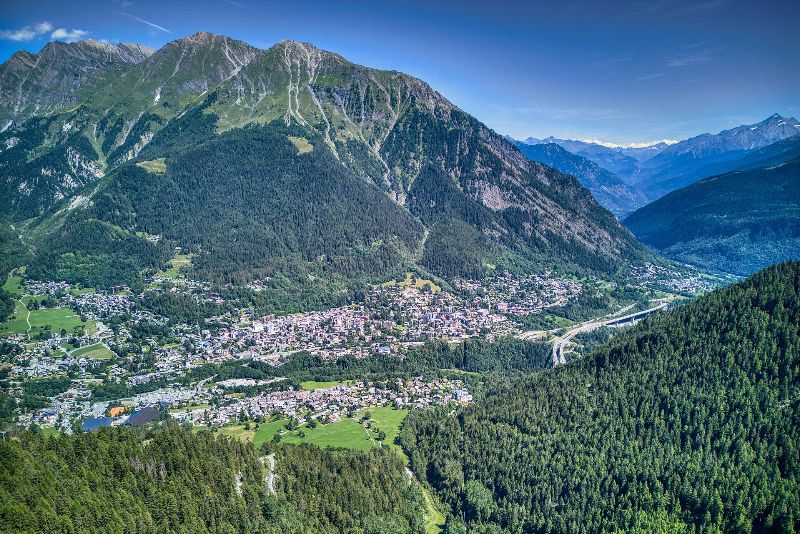
From the Mont Blanc Tunnel, the road drops directly into Courmayeur, and the motorway continues down the valley towards Aosta. La Thuile is reached from Pré-Saint-Didier by a winding road that climbs steadily, often snowy in midwinter; the Little St Bernard Pass beyond it, linking with France, is closed in winter. Cervinia lies at the head of the Valtournenche, reached from Châtillon by a long climb of many bends, with snow common in the upper part. Pila is reached from Aosta by road or by gondola from the town. Each of these final climbs is where winter equipment really matters.
Realities on the ground
In practice, the main valley roads in the Aosta Valley are well cleared and gritted, and the motorway is rarely a problem. The challenges are on the side valleys after fresh snowfall, on shaded bends where ice lingers, and on busy weekends when holiday traffic coincides with snow. Chain-fitting areas are provided on the main climbs. Arriving in the evening after a flight, in the dark and in falling snow, is the scenario in which an experienced driver makes the biggest difference. Planning for the occasional delay is sensible: a flexible restaurant booking on arrival night is better than a tight one.
Combining France, Switzerland and Italy
A transfer from Geneva to the Aosta Valley crosses up to three sets of rules: Swiss roads around the airport, the French mountain law on the approach to Chamonix and the Italian requirements beyond the tunnel. Via the Great St Bernard, the route stays in Switzerland until the Italian border instead. A vehicle equipped for the strictest of these, with winter tyres and chains on board, satisfies them all. That is the standard approach for any professional transfer operator in the Alps. For travellers, it also means one less thing to research before the trip: the differences in national rules are real, but they matter only to whoever is responsible for the vehicle. On the return journey to Geneva, the same equipment and the same care apply, and the timing is planned around your flight.
Planning your Italian transfer with AirportsTransfers.ch
When you book a transfer from Geneva Airport to Courmayeur, La Thuile or Cervinia with AirportsTransfers.ch, you see a fixed price per vehicle before paying online by card, Apple Pay or Google Pay, with tolls included. Your chauffeur meets you in arrivals with a name sign, tracks your flight and waits if it is late. Vehicles include the Mercedes E-Class and S-Class, the V-Class for up to seven passengers with skis, and the Sprinter for groups. Child seats can be requested, skis are declared at booking, and the team answers 24/7 on +41 78 346 56 77 by phone or WhatsApp.