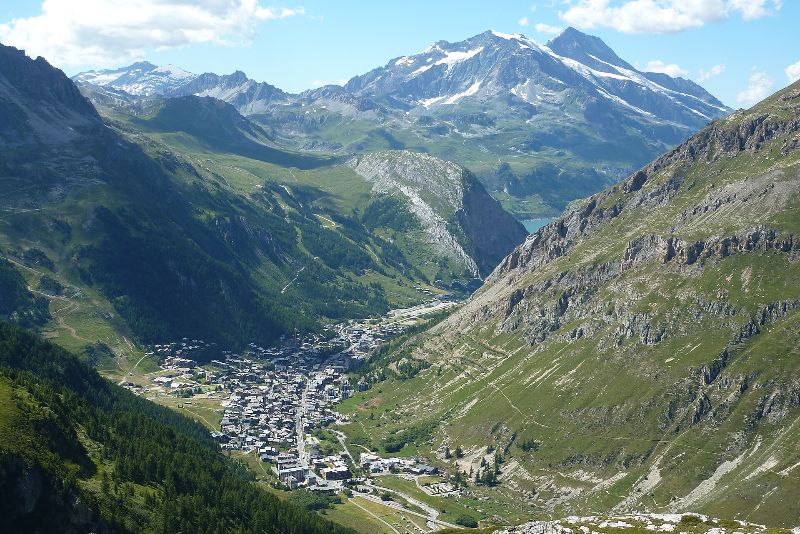
Snow chains become compulsory on Alpine roads wherever a round blue sign showing a tyre wrapped in a chain is displayed, whatever tyres the vehicle has. On the climbs to ski resorts in Switzerland, France and Italy, this happens regularly after fresh snow, including on roads to places such as Val d'Isère, about 180 km and 2 h 45 from Geneva Airport. On a transfer with AirportsTransfers.ch, the chauffeur carries chains and fits them when the sign appears.
- When: wherever the round blue chain sign is shown
- Who: all vehicles, including four-wheel drive
- Where to fit: on the driving wheels, in a safe lay-by or chain bay
- Driving with chains: reduced speed, remove on clear roads
- Alternatives: textile snow socks are accepted in some situations
The chain sign and what it means
The sign is the same across the Alpine countries: a blue disc with a white wheel and chain. It means chains must be fitted from that point until a sign with a red diagonal bar marks the end of the obligation. It does not matter whether the car has excellent winter tyres or four-wheel drive; the rule applies to all. Police sometimes check at the bottom of resort roads, and in heavy snow vehicles without chains may be turned back. The sign is usually activated only when snow is on the road, so on a clear day the same climb may have no requirement at all.
Where chains are fitted
On the main climbs, chain bays or wide lay-bys are provided just below the point where chains become mandatory, so that drivers can stop safely off the carriageway. Fitting chains on a narrow bend or on the road itself is dangerous and should be avoided. In a busy chain bay on a snowy Saturday, a dozen cars may be stopped at once, with drivers kneeling in the slush, so good organisation helps: hazard lights on, a high-visibility vest, gloves, a torch after dark and a mat to kneel on. Once the steep section is over and the road is clear, chains should be removed, ideally in another lay-by, as driving on bare tarmac damages both chains and road.
How chains are fitted
Chains go on the driving wheels: the front wheels on most cars, the rear wheels on many larger vehicles, and normally the front on four-wheel-drive cars unless the manufacturer advises otherwise. Modern chains are designed to be fitted without moving the car, by placing the cable behind the tyre, connecting it and tightening the chain over the tread, then checking it after a short distance. With practice it takes a few minutes per wheel; the first attempt, in the dark and the cold, can take much longer. Speed must be reduced while chains are on, and sudden braking or acceleration should be avoided.
Snow socks and other devices
Textile snow socks, which slip over the tyre, have become popular because they are light and quick to fit. In France they are accepted as an alternative to chains under the mountain law, but they are less durable on longer stretches and may not satisfy every requirement everywhere. Some vehicles also have automatic chain systems. For professional transfers, metal chains matched to the tyre size remain the standard, with each vehicle carrying its own set throughout the winter. Whichever device is used, it must fit the exact tyre size of the car, which is one reason rental-car customers are sometimes surprised to find the chains supplied do not fit, or are missing altogether.
Why experienced drivers handle it
On a ski transfer, the chain sign tends to appear exactly when conditions are hardest: on the final climb, after dark, in falling snow. A chauffeur who drives these roads every week knows where the chain bays are, fits chains quickly and safely, and judges whether the conditions call for them even before the sign is lit. Passengers stay warm in the car, and the delay is usually a matter of minutes rather than a struggle in the snow. A van such as the Mercedes V-Class, loaded with skis and luggage, is handled with the same care as a sedan, with chains fitted to suit the vehicle.
Booking a winter transfer with AirportsTransfers.ch
With AirportsTransfers.ch, your transfer to any Alpine resort comes with a winter-equipped vehicle and an experienced driver. You see the fixed price for the vehicle online before paying by card, Apple Pay or Google Pay, and the chauffeur meets you at Geneva Airport with a name sign, having tracked your flight, with waiting included if it is delayed. Choose a Mercedes E-Class or S-Class, a V-Class for up to seven passengers and their skis, or a Sprinter minibus. Child seats are fitted on request and skis are declared at booking. Call or message +41 78 346 56 77, day or night.