The Bernina Pass road links Pontresina in the Upper Engadin with Poschiavo and the Italian town of Tirano in Valtellina, passing glaciers, high lakes and a valley that descends from snow to vineyards in a short distance. It is a key route for travellers continuing from St. Moritz towards Bormio, Lake Como or the Italian Alps. St. Moritz lies about 400 km and 5 h from Geneva Airport, and AirportsTransfers.ch can plan a through journey that includes the Bernina.
- Route: St. Moritz – Pontresina – Bernina Pass – Poschiavo – Brusio – Tirano
- Highlights: Morteratsch glacier, Lago Bianco, the Poschiavo valley
- Season: generally open all year, with possible closures during storms
- Border crossing: into Italy between Campocologno and Tirano
- Onward: Valtellina towards Sondrio, Bormio or Lake Como
Leaving the Engadin: Pontresina and the glaciers
The road leaves the Engadin at Pontresina, a resort village just east of St. Moritz, and climbs gently through the Val Bernina. A few minutes later the Morteratsch glacier comes into view on the right, flowing down from the Bernina massif. Markers along the walking path to its snout show how far the ice has retreated over the decades, and it is a short, popular stop for those not in a hurry.
Further up, the valley station of the Diavolezza cable car serves a viewpoint facing Piz Palü and Piz Bernina, the highest summit in the Eastern Alps. The road then crosses open, treeless country with small lakes and wide views, a landscape that feels more like high tundra than a mountain valley.
The summit and Lago Bianco
The pass itself sits at around 2,330 metres. Here the road runs past Lago Bianco and Lago Nero, two lakes separated by a watershed: water from one flows towards the Black Sea via the Inn and Danube, and from the other towards the Adriatic via the Adda and Po. The Bernina railway, part of a UNESCO-listed line, follows the opposite shore of Lago Bianco, and its red trains are often seen crossing the snowfields.
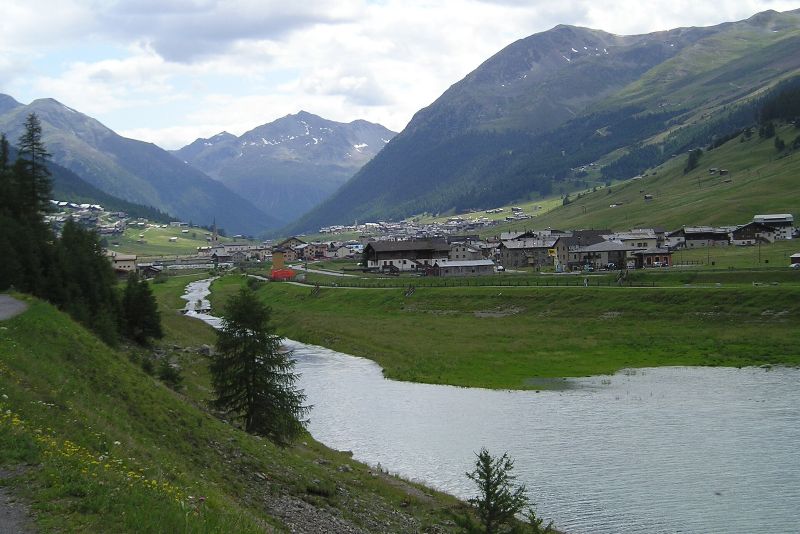
Just beyond the summit, a side road branches towards the Forcola di Livigno and the duty-free Italian valley of Livigno. That road closes in winter, while the main Bernina route stays open.
Down to Poschiavo and Brusio
The southern descent is long and steep, falling well over a thousand metres in a series of hairpins to the Val Poschiavo. The valley is Italian-speaking but Swiss, and Poschiavo, its main town, has a handsome piazza and grand houses built by families who made their fortunes abroad. The lake of Poschiavo sits further down the valley, followed by Brusio, where the railway famously loops through a circular stone viaduct to lose height.
The change in vegetation along this descent is striking. Larch and stone pine give way to chestnut trees and then to vineyards as the road approaches the Italian border, and in spring it is common to leave snow at the pass and find blossom in the valley an hour later.
Tirano and the Valtellina
The frontier lies between the Swiss village of Campocologno and Tirano. As both countries belong to the Schengen area, the crossing is usually smooth, but passports or identity cards should be carried and customs officers may check vehicles. Tirano is a lively small town and the terminus of the Bernina railway, with a large sanctuary church at its edge.
From Tirano, the Valtellina runs west towards Sondrio and Lake Como, its south-facing slopes covered in terraced vineyards. Food lovers know the valley for bresaola and pizzoccheri, buckwheat pasta with cheese and greens. Turning east instead leads up to Bormio and the Stelvio region.
Seasonal conditions on the Bernina
The Bernina is maintained as an all-season road, but its altitude means it is exposed to wind and drifting snow. During and after heavy snowfall it can close for some hours, occasionally longer, and convoy or chain requirements may apply. Summer brings cyclists and motorbikes, and slower traffic on the hairpins.
Because conditions on both sides can differ sharply, chauffeurs check road status in the morning and adapt the plan if needed. If the Bernina is closed, the alternative is the Maloja route via Chiavenna, which is lower and generally more sheltered.
Booking a transfer over the Bernina
Long, multi-country journeys are simpler with one driver from start to finish. Book with AirportsTransfers.ch and you will see a fixed price per vehicle before paying online by card, Apple Pay or Google Pay. Your chauffeur greets you with a name sign at Geneva Airport, monitors your flight and waits at no extra charge if it is delayed. Child seats are supplied on request, and skis and other sports equipment should be mentioned at booking so the vehicle has room. To discuss an itinerary through the Engadin into Italy, phone or WhatsApp +41 78 346 56 77.