Fribourg
Fribourg is 135 km from Geneva Airport, a drive of about 1 h 30 on Swiss motorways with no border to cross. Built on sandstone cliffs above a loop of the Sarine river, it is one of the country's most complete medieval cities and sits right on the line between French- and German-speaking Switzerland. A private car from AirportsTransfers.ch takes you from the arrivals hall to your hotel in the old town or the university quarter.
- Distance from GVA: 135 km by road
- Drive time: about 1 h 30
- Border crossing: none
- Best for: medieval architecture, university visits, Gruyère and Murten day trips
- Languages: French and German, often side by side
Getting from Geneva Airport to Fribourg
The usual route follows the A1 to Lausanne, then climbs away from the lake on the A12 through the green foothills of the Gruyère region, passing Bulle before descending towards Fribourg. It is an attractive drive, with views back over Lake Geneva and, on clear days, of the Prealps to the south. An alternative runs via Yverdon and Payerne on the A1 towards Bern; depending on traffic around Lausanne either can be quicker, and a chauffeur will choose on the day.
Arrival in Fribourg itself is simple: the modern town around the station sits on the plateau, while the old town spills down the cliffs to the river. Many hotels are on the plateau, but a few are in the lower town, where streets are steep and narrow, so door-to-door drop-off saves dragging luggage over cobbles.
The old town, bridges and cathedral
The heart of Fribourg is its Gothic Cathedral of St Nicholas, whose tower dominates the skyline and can be climbed for a view over the rooftops and the river gorge. Below it, the old town falls away in terraces towards the Sarine, through the quarters of the Bourg, the Auge and the Neuveville, each with fountains, chapels and sandstone houses that have changed little over centuries. The river is crossed by a succession of bridges, from the covered wooden Pont de Berne in the Auge to high modern spans above the valley.
One local curiosity is the Neuveville–Saint-Pierre funicular, which links the lower and upper town and is driven by the weight of water rather than electricity, making it a small piece of working engineering heritage. Contemporary art has its place too: an exhibition space dedicated to Jean Tinguely and Niki de Saint Phalle, both closely linked to the city, sits in a former tram depot near the centre.
A bilingual university city
Fribourg's university teaches in both French and German, and that mix shapes everyday life: street names appear in two languages, and you will hear both in cafés and shops. The large student population keeps the centre lively during term, and the city hosts academic conferences, Catholic institutions and a number of research and training centres. For business travellers, the location is practical, halfway between Lausanne and Bern, with good rail links to both capitals once you are there.
When choosing where to stay, the area around the station and the Pérolles boulevard suits short business trips, with straightforward access by car and on foot. Visitors on a leisure break often prefer the old town for atmosphere, accepting that streets are steeper and quieter in the evenings.
Food and day trips around Fribourg
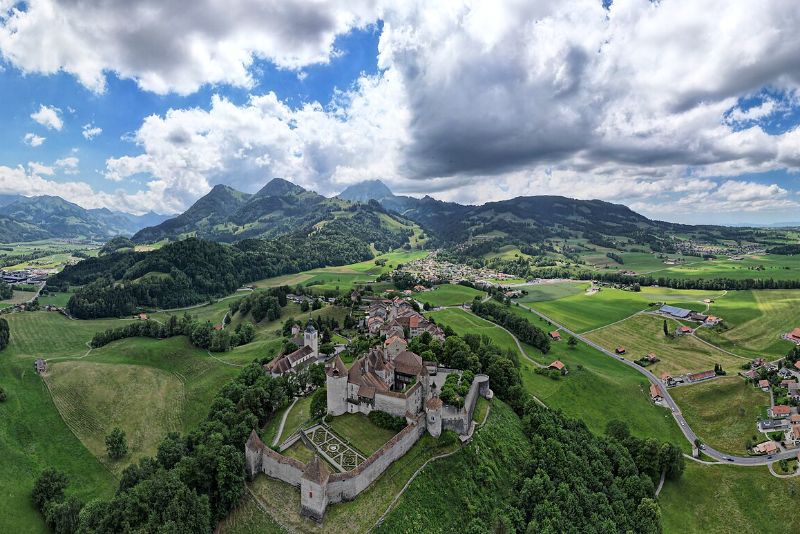
Fribourg is cheese country. The canton is home to Gruyère and Vacherin Fribourgeois, and the local fondue moitié-moitié blends the two. Meringues with double cream from the Gruyère region are a traditional dessert, and the chocolate-making heritage of Broc is close by. The most popular day trip is to the hilltop castle town of Gruyères itself, about half an hour south, with its single sloping main street and views across the Prealps.
- Gruyères and its castle, plus the cheese dairies of the region
- Murten/Morat, a walled lakeside town with ramparts you can walk along
- Bern, the federal capital, around half an hour by motorway
- The Lac de la Gruyère for walks and cycling
Murten in particular rewards a few hours: its arcaded main street and intact ramparts overlook a small lake, and it is another place where French and German meet.
Practical tips for visitors
Fribourg is easy to walk, but the gradients are real, so comfortable shoes matter more than in most Swiss cities. Winters are colder than on Lake Geneva and can bring fog in the river valley, while late spring and early autumn are pleasant for exploring on foot. If you plan to combine Fribourg with Gruyères or Murten on the same trip, a chauffeur by the hour, from a minimum of two hours, can be easier than juggling regional trains.
How to book your Fribourg transfer
Book online with AirportsTransfers.ch and the fixed price per vehicle is displayed before you confirm, with secure payment by card, Apple Pay or Google Pay. On arrival your chauffeur is in the hall holding a sign with your name, having followed your flight so that a delay does not cost you extra waiting time. Ask for child seats when booking, and list any skis or bulky luggage so we send a suitable car, from a Mercedes E-Class to a V-Class van. Companies can receive invoices, and return journeys can be booked at the same time. Questions are answered on +41 78 346 56 77 by phone or WhatsApp.